
example.com
A possible main domain for the organization's certificate request.

Organization validation (OV)
Combine a single-domain HTTPS requirement with verification of the organization behind it. This OV option suits businesses whose policies or procurement requirements call for organization-validated certificate information.
Know the names you are securing
OV adds organization identity checks to domain-control validation. Your website's exact hostname list still determines the coverage required.
A possible main domain for the organization's certificate request.

An alias to include in the proposed request when visitors use it.
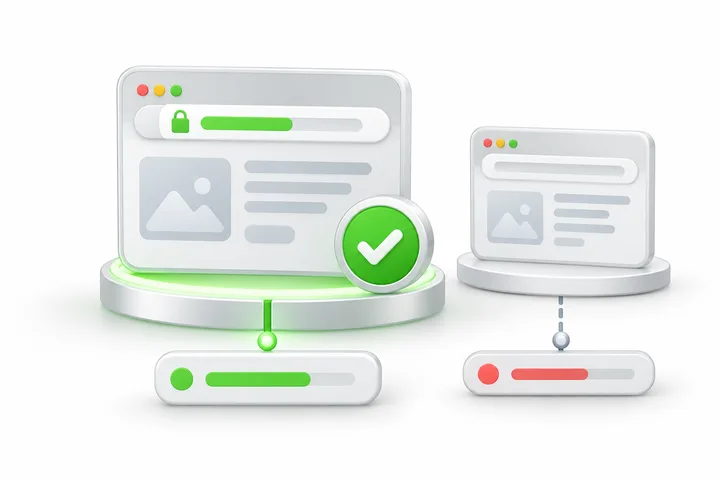
A separate hostname that is not covered merely because the organization owns it.
Organization validation does not expand name coverage or inherently provide stronger encryption than DV. Confirm required hostnames and alias rules before purchase.
Match the requirement
Start with the addresses you need to protect and the identity checks your organization requires.

A business or institution that needs organization identity checked as part of issuance.

A project where the customer's own policy specifies an organization-validated certificate.

A single-domain service with a team ready for validation and deployment.
HTTPS encrypts data in transit between supported clients and a correctly configured server. It does not guarantee that a website is malware-free or replace secure application and server administration.
Before you begin
Prepare the correct organization name, an appropriate verification contact and the exact hostname list. Supporting information depends on the issuer's current requirements.

A CSR is request data, not a private key. Keep private keys, passwords, payment-card details and identity documents out of ordinary website enquiry forms.
A manual process, with clear responsibilities
SDH coordinates your order and request, the certificate authority validates and issues, and your administrator arranges deployment.

Select a one-, two- or three-year billing term for SDH High Assurance SSL. Review the full upfront total, same-cycle renewal amount and required names before proceeding.

Review the chosen certificate, billing term and full-term total at checkout before paying. SDH manually coordinates the request and confirms any additional assistance separately.

Have your administrator prepare the CSR and agree the requested domain and aliases before supplying organization information through the agreed validation process. Complete domain-control and organization checks. Issuance depends on the required evidence being accepted, so no fixed delivery time is promised.

Receive the issued certificate and applicable chain from SDH. Your administrator installs them, configures HTTPS and checks the names. Agree any SDH deployment assistance separately.
Your selected 1-year term is paid in full upfront and renews on the same cycle. It does not produce one certificate valid for an unrestricted period. CA and browser rules determine individual certificate validity. Reissuance, validation and replacement installation may be required within a billing term.
Understand the purchase
Choose the right certificate coverage and agree any additional technical assistance separately.

SDH coordinates fulfillment and applicable validation guidance. Browser and device trust depends on valid issuance, supported clients and correct server configuration.

Keep organization contacts accurate throughout the subscription. Replacement can require fresh domain or organization checks as well as deployment of the newly issued certificate.
Renews at USD $43.19 every year. Your service keeps its recorded recurring amount; later catalog updates do not change it automatically. Reissuance follows the issuer's rules, with deployment assistance and name changes agreed separately.
Frequently asked questions

OV verifies the organization as well as domain control. That identity check does not expand the single-domain coverage.
Browser vendors control that display. OV verifies organization information in the certificate; it does not promise a particular badge or address-bar appearance.
The issuer determines the evidence required for the organization and request. SDH coordinates those requirements rather than prescribing a universal document list.
Organization checks and domain coverage are separate decisions. Consider SDH OV Multi-Domain SSL for a defined set of names, with the allowance confirmed before purchase.
No. The certificate purchase does not include installation, server repair, mixed-content fixes or continuous certificate management. Your hosting administrator installs and verifies the certificate; ask SDH about separately agreed assistance if needed.
No. Choose one, two or three years and pay that billing term in full upfront. Individual certificate validity follows CA and browser rules, so reissuance, validation and replacement installation may be needed within the selected term.
Renews at USD $43.19 every year. Your selected 1-year billing cycle repeats. Renewal invoices may appear before the due date under SDH's 15-day invoice window; check the dates shown for your service.
That depends on your existing payment arrangement. A recurring billing cycle does not guarantee an automatic charge.
No. Existing services have their own recorded recurring amounts. A later catalog price change does not automatically update your service's renewal amount.
A certificate signing request (CSR) identifies the requested certificate and its public key. Your administrator generates it and retains the corresponding private key. Never send private keys or passwords in an inquiry.
Delivery depends on the selected certificate, complete information, domain-control checks and any organization validation. SDH manually coordinates fulfillment and advises on progress; no fixed issuance deadline is promised.
Ask SDH to review the new hosting, names and key requirements. A reissue and fresh validation may be required under the issuer's rules. Replacement installation and additional technical work are agreed separately.
Compare the alternatives

Choose DV if organization verification is not required.
Explore this certificate
Consider extended organization checks for one domain.
Explore this certificate
Consider OV across an explicit set of names.
Explore this certificateTell SDH what you need to secure. Include public hostnames and a short overview of the requirement.